
By Dr. Nalini Chilkov, Founder
CONFUSED about SOY?
If you’ve been diagnosed with cancer—especially hormone-sensitive breast cancer—you’ve likely been told to avoid soy. You may have heard that soy “feeds” cancer. Maybe even your oncologist advised you to steer clear of it entirely.
This guidance is outdated. In fact, the most current and comprehensive research tells us something very different:
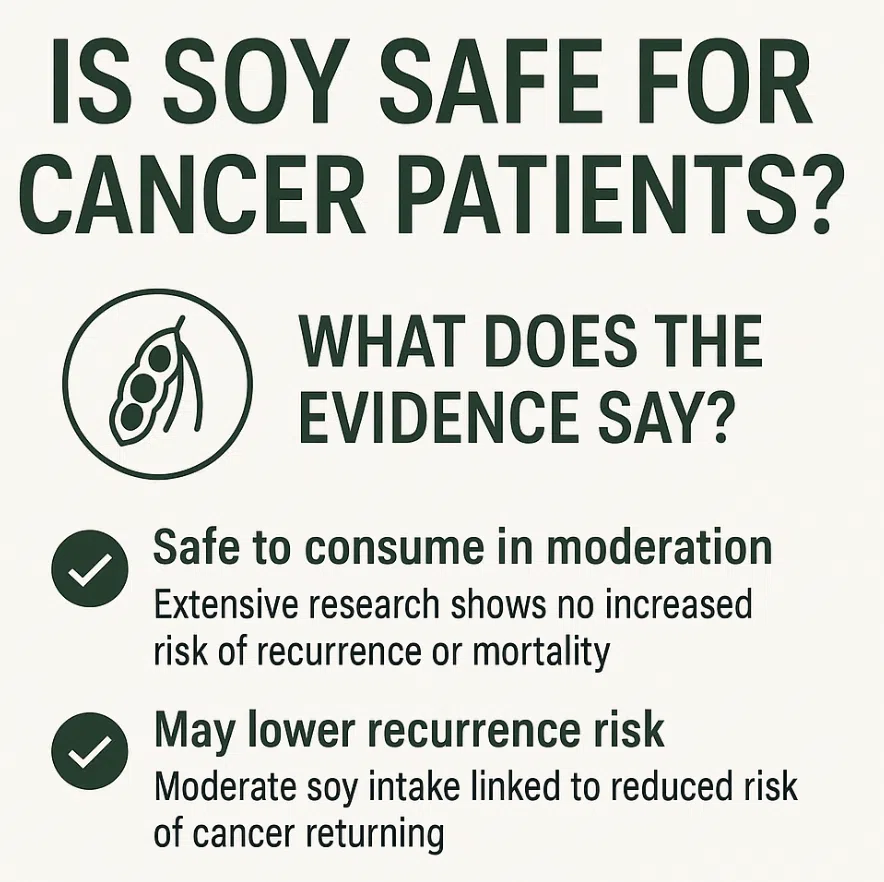
Whole soy foods are not only safe for cancer patients—they may actually reduce the risk of recurrence and improve survival.
What’s the Concern About Soy?
Soybeans contain compounds called isoflavones, which are often labeled as “phytoestrogens”—plant molecules that can bind to estrogen receptors in the body.
This has understandably caused concern, particularly among women with estrogen receptor–positive (ER+) breast cancer, where estrogen can drive tumor growth.
However, it’s important to understand that isoflavones do not act like human estrogen. They bind selectively and weakly to estrogen receptors—particularly to the beta subtype, which has been shown to produce anti-proliferative, anti-inflammatory effects in breast tissue. This selective action may actually block the effects of stronger, more aggressive estrogens.

What the Evidence Says
Over the past 15 years, multiple large-scale studies have investigated the effects of soy intake in breast cancer patients:
- A 2009 prospective study of over 5,000 breast cancer survivors in China found that women with the highest intake of soy protein had a 32% reduction in recurrence and a 29% reduction in all-cause mortality.
- A U.S.-based study followed nearly 2,000 breast cancer survivors and showed similar findings: soy intake was associated with lower recurrence risk, particularly in women with ER+ tumors—even those on tamoxifen.
- A 2022 systematic review of 81 prospective cohort studies confirmed that soy and soy isoflavones are associated with a 10% reduction in overall cancer incidence.
These studies have not found any harmful effect of soy on estrogen levels, breast tissue density, or cancer progression markers.
The Form Matters: Whole Soy vs. Processed Soy
These benefits are linked to whole soy foods, such as:
- Tofu
- Tempeh
- Edamame
- Miso
- Unsweetened soy milk
Avoid highly processed soy products, such as soy protein isolates, powders, and bars. These are not included in the studies showing benefit and may behave differently in the body.
A typical beneficial intake is 1 to 2 servings of whole soy foods per day. For example, one cup of soy milk and half a cup of tofu or edamame.
The Bottom Line
- Whole soy foods are safe and beneficial for most cancer patients, including those with ER+ breast cancer.
- There is no evidence that soy increases cancer risk.
- There is strong evidence that soy may reduce the risk of recurrence and support long-term survival.
If soy has been part of your diet, you do not need to eliminate it. If you are considering adding it, choose minimally processed, organic sources and include them as part of a diverse, nutrient-dense diet.
You Deserve a Health Plan—Not Just a Disease Plan
At the OutSmart Cancer® System, we teach patients how to build a body and a biology where cancer cannot thrive. Nutrition is a critical part of that plan.
Cancer is not in control. You are.
You can take action to protect your health during and after treatment.
Learn More
Visit OutSmartCancer.com to access evidence-based guidance, programs, and support for every stage of your cancer journey.
If this article was helpful, please share it, subscribe, and help us reach others who need clarity and confidence in their healing path.
Live Long. Live Well.